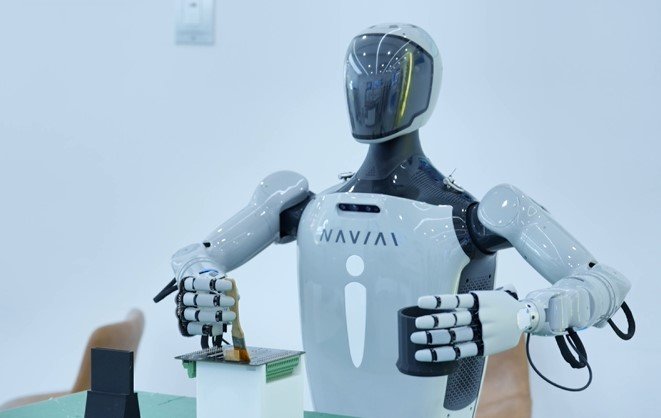

As humanoid robots move from research laboratories into factories, healthcare environments, and everyday life, a newly released documentary-style video offers a rare look inside the industrial ecosystem powering China’s next generation of robotics innovation.
Released ahead of the Fourth China International Supply Chain Expo (CISCE), Behind CISCE with Jason: How China’s Supply Chain Is Building Tomorrow’s Robots follows American presenter Jason on a journey through Zhejiang Province, one of China’s leading centers for robotics development and advanced manufacturing.
The program highlights how companies across multiple layers of the supply chain are collaborating to advance embodied artificial intelligence, a rapidly emerging field focused on integrating AI with physical machines capable of interacting with the real world.
From Robot Brains to Advanced Motion Systems
Rather than focusing on a single technological breakthrough, the episode showcases how a network of specialized companies contributes to the creation of increasingly capable humanoid robots.
At the Zhejiang Humanoid Robot Innovation Center in Ningbo, Jason encounters robots designed to perform laboratory experiments, assist industrial production processes, and support household applications. The demonstration provides insight into how humanoid robots are gradually expanding beyond research environments and entering commercial and consumer settings.
The tour continues at Zhejiang Fine Motion Robot Joint Technology Co., Ltd., where engineers develop precision reducers—critical components often described as the “joints” of industrial and humanoid robots. These devices enable smooth, precise, and powerful movements that are essential for advanced robotic functionality.
Human-Machine Interaction Reaches New Levels
Another stop takes viewers to GravityXR, where developers are exploring technologies that enhance human-machine interaction through robotic avatars, spatial computing systems, and real-time facial expression replication.
Using advanced digital face technologies and remote embodiment solutions, the company is working to create robots capable of mirroring human emotions and movements with increasing realism, potentially expanding applications across communication, customer service, healthcare, and remote operations.
Brain-Computer Interfaces Expand Robotic Capabilities
The final destination is BrainCo, a Hangzhou-based company specializing in brain-computer interface (BCI) technologies.
There, Jason experiences advanced prosthetic systems and dexterous robotic hands that interpret muscle and nerve signals through non-invasive neural technologies. The company’s latest robotic hand features 21 degrees of freedom and integrated tactile sensing, demonstrating how next-generation interfaces could improve both assistive technologies and humanoid robotics.
Industry experts increasingly view BCIs as a critical frontier in robotics development, enabling more intuitive communication between humans and intelligent machines.
Supply Chain Collaboration Drives Robotics Innovation
Throughout the program, a central theme emerges: the future of humanoid robotics depends not on individual breakthroughs, but on collaboration across an increasingly sophisticated supply chain.
From sensors, semiconductors, and precision components to AI algorithms, software platforms, and application developers, the development of advanced robots requires coordination among companies operating across multiple sectors.
The documentary also highlights the role of the China International Supply Chain Expo as a platform designed to strengthen connections between upstream suppliers, manufacturers, technology providers, and end users.
The Fourth China International Supply Chain Expo is scheduled to take place in Beijing this June and will feature its first dedicated Artificial Intelligence exhibition area.
Source: China.org.cn