
A warehouse robot that eliminates a few miles of walking per employee can matter more to a retailer’s margins than a flashy humanoid demonstration. That is the central tension in robotics industry trends: capital is chasing machines with broad future potential, while buyers still demand measurable gains in labor productivity, throughput, safety, and uptime.
For investors and business leaders, robotics is no longer a single manufacturing story. It sits at the intersection of artificial intelligence, semiconductor supply, onshoring, defense spending, aging populations, and e-commerce logistics. The winners will not necessarily be the companies with the most viral videos. They will be the ones that can deploy equipment reliably, integrate it with existing operations, and prove a compelling return on investment.
Robotics Industry Trends Moving Capital and Production
The industrial base remains the market’s foundation. Automotive manufacturers have used robots for decades, but demand is spreading into batteries, electronics, food processing, pharmaceuticals, consumer goods, and logistics. The International Federation of Robotics has estimated that the global operating stock of industrial robots has moved above four million units, a signal that automation is becoming core production infrastructure rather than a niche capital expense.
The next phase is less about simply adding robot arms to factory lines. Manufacturers want flexible cells that can handle shorter product runs, more product variations, and volatile demand. That favors collaborative robots, machine vision, autonomous mobile robots, and software that lets operators change tasks without extensive reprogramming.
This shift also reflects a harder economic reality. U.S. manufacturers face persistent pressure from skilled-trades shortages, wage costs, and the need to reduce dependence on distant supply chains. A robot does not remove every labor problem. It creates demand for technicians, controls engineers, and maintenance staff. But it can make domestic production more viable where repetitive tasks are difficult to fill or where quality failures are expensive.
For corporate buyers, the calculation is increasingly about total cost of ownership. A lower-priced machine that causes frequent stoppages can destroy the business case. Suppliers with strong service networks, spare-parts availability, cybersecurity practices, and integration expertise may have an advantage over companies selling impressive hardware without a proven deployment model.
AI is making robots more useful, not magically autonomous
Generative AI has reshaped the conversation around robotics, especially as major technology companies promote models that can interpret images, language, and physical environments. The practical opportunity is substantial. Better perception can help robots identify irregular objects in a bin, inspect defects, navigate changing warehouse layouts, or respond to spoken instructions.
Yet physical AI has a much higher bar than a chatbot. A language model can produce an incorrect answer with limited immediate consequence. A warehouse vehicle that misreads a pedestrian, a robotic arm that damages inventory, or a surgical system that behaves unpredictably carries operational and legal risk. Robotics firms must combine AI models with sensors, safety controls, simulation, deterministic software, and human oversight.
That makes compute a strategic input. Nvidia and other chip suppliers are positioning their hardware and software as the training and inference layer for autonomous systems. But the spending path could be uneven. Large developers may invest heavily in data centers, simulation environments, and proprietary datasets before revenue catches up. Investors should distinguish between near-term sales of AI infrastructure and the longer-term, less certain economics of robot deployment.
Humanoids Are a High-Stakes Bet, Not Yet a Labor-Market Shock
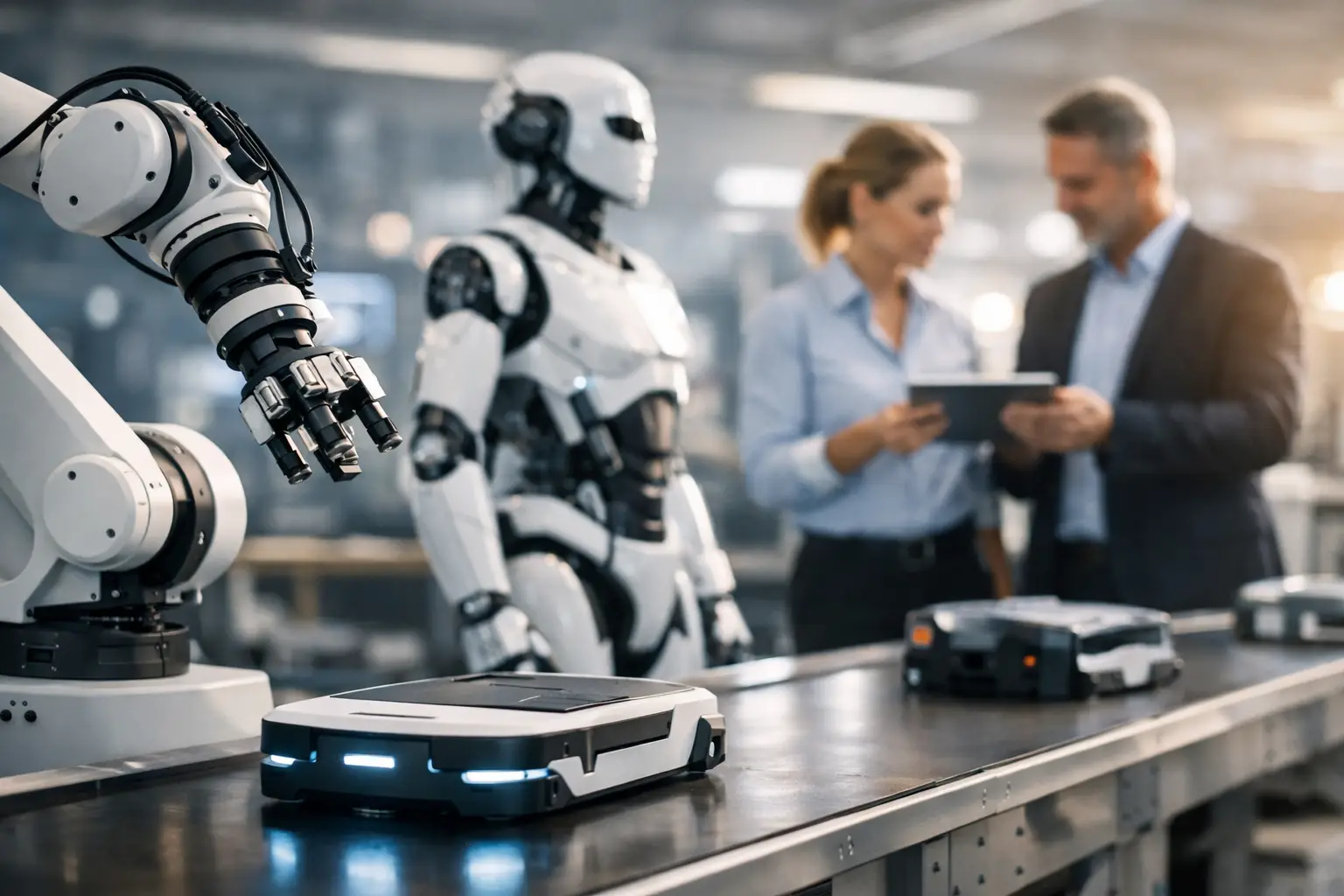
Humanoid robots have become the most visible part of the sector, backed by substantial funding rounds, high-profile partnerships, and demonstrations from companies including Tesla, Figure, Agility Robotics, and Boston Dynamics. The appeal is straightforward: factories and warehouses were built for people. A machine with a human-like form could, in theory, use existing stairs, tools, shelves, and workstations without requiring a complete site redesign.
The business case remains unproven at scale. Humanoids have many moving parts, demanding battery requirements, and difficult safety challenges. Their value will depend on how often they can complete a useful task without intervention, how quickly they can be repaired, and whether they outperform simpler alternatives.
In many settings, a purpose-built machine will remain the better investment. A mobile robot can move totes across a warehouse more cheaply than a bipedal machine. A fixed robotic arm can package products faster and more consistently. Humanoids may first find traction in tasks where facilities change often and the work requires a mix of mobility, reach, and basic manipulation.
That does not make the category irrelevant. It makes it venture-like. A small number of platforms could become valuable if they achieve reliable, repeatable deployments. Many others may face a long and expensive path between pilot programs and recurring revenue. Public-market investors should be cautious about treating every humanoid announcement as evidence of an imminent productivity boom.
Warehouses, Health Care, and Defense Are Setting the Near-Term Pace
Warehousing is one of robotics’ clearest commercial markets because the metrics are visible. Order volumes, picks per hour, labor turnover, workplace injuries, and fulfillment costs all give operators a way to measure results. Amazon has made automation central to its logistics strategy, while retailers, third-party logistics providers, and grocery chains are expanding deployments of sorting systems, autonomous mobile robots, and inventory-scanning tools.
The trade-off is integration complexity. A warehouse is a living operation with seasonal spikes, legacy software, narrow aisles, and workers performing exceptions that automation cannot easily handle. The strongest robotics vendors sell an operating system for the facility, not merely a device. They connect equipment to warehouse-management software, provide fleet coordination, and help customers redesign workflows.
Health care offers an equally significant but slower-moving opportunity. Surgical robotics, rehabilitation devices, pharmacy automation, and hospital logistics can address staffing constraints and improve consistency. Regulatory approval, clinical evidence, reimbursement rules, and patient safety make this market harder to enter than warehouse automation. Those barriers can also protect companies that establish a durable installed base.
Defense is another major force reshaping demand. The war in Ukraine and rising geopolitical tension have underscored the value of drones, uncrewed ground systems, autonomous maritime platforms, and counter-drone technology. Governments want faster procurement and domestic supply chains, which could support a broader group of defense technology suppliers. At the same time, budget timing, export restrictions, and ethical concerns around autonomous weapons create policy risk that does not apply to commercial automation.
The Software and Service Model Will Decide Who Keeps the Revenue
Hardware is often the headline, but software is where recurring economics can emerge. Fleet-management platforms, simulation tools, remote monitoring, vision systems, and maintenance analytics can produce ongoing revenue after installation. They also generate operational data that may improve performance across a customer’s network.
Robotics-as-a-service is gaining ground because it changes the purchasing decision. Rather than making a large upfront capital commitment, a customer may pay by month, by task, or by unit of output. That can lower adoption barriers for smaller businesses and make automation easier to test. It also shifts financing, utilization, and residual-value risk onto the provider.
The model works best when the task is standardized and demand is predictable. A cleaning robot in a large retail chain or a mobile platform moving goods in a stable warehouse can support recurring pricing. Highly customized factory automation may still require a conventional equipment sale and a lengthy integration project. Investors should pay close attention to churn, gross margins, service costs, and utilization rates before assigning software-like valuations to a robotics company.
Components and policy can still disrupt the growth story
Robotics supply chains rely on semiconductors, precision gearboxes, motors, sensors, batteries, and specialized manufacturing capacity. China remains a critical production center and a major end market, while the U.S., Japan, South Korea, Taiwan, and Europe hold important positions in chips, controls, machinery, and industrial automation. Trade restrictions or export controls can affect both costs and sales opportunities.
Cybersecurity has also moved from a technical footnote to a board-level issue. Connected robots collect data, receive remote updates, and can become entry points into factory or hospital networks. A security failure can halt operations and expose sensitive data. Customers are likely to favor vendors that can meet demanding security and compliance standards, even if that extends sales cycles.
The labor question will remain politically charged. Robotics can displace specific tasks, particularly repetitive work, but it can also increase output, support reshoring, and create demand for higher-skilled roles. The result will vary by region, industry, and employer. Companies that invest in worker training and communicate clearly about job redesign are more likely to capture automation benefits without creating avoidable disruption.
For readers tracking the sector, the useful signal is not the most cinematic robot clip. Watch for repeat orders, customer retention, deployment time, gross-margin improvement, and evidence that a machine performs through a full operating shift. Those measures will show whether robotics is producing durable cash flow or simply attracting the market’s latest burst of technological optimism.