
A majority of American adults believe Halloween should become a national holiday, according to a new survey released Monday by Italian confectionery group Ferrero, highlighting changing consumer attitudes toward a celebration traditionally associated with children.
The company’s third annual Halloween Report found that 58% of U.S. adults support making Halloween a national holiday, while 70% believe the celebration belongs equally to adults and children, up from 62% in 2025.
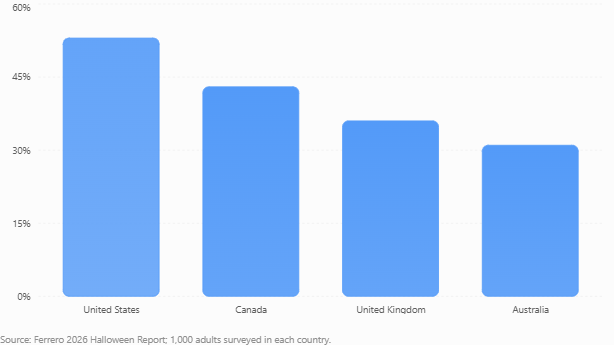
For the first time in the survey’s three-year history, a majority of respondents, 53%, identified Halloween as one of their favorite holidays, compared with 47% a year earlier.
The findings suggest that Halloween is becoming an increasingly established part of adult consumer culture, influencing spending habits, entertainment preferences and seasonal celebrations.
Adults Are Redefining Halloween Celebrations
Ferrero’s research indicates that Americans are embracing Halloween beyond traditional activities such as trick-or-treating and children’s costume parties.
Among parents surveyed, 81% said Halloween should be celebrated by adults as much as children, an increase from 71% in 2025.
Meanwhile, 62% of adults said they deserve a Halloween celebration of their own, compared with 54% last year.
However, growing enthusiasm does not necessarily translate into increased demand for large gatherings or nightlife.
According to the survey, 62% of respondents described staying home as their ideal Halloween evening.
Watching horror movies or television shows was cited by 40% of adults, second only to decorating their homes, at 43%.
The most popular activity respondents planned to try in 2026 was spending a comfortable evening at home with candy and streaming entertainment, selected by 37%, compared with 23% who favored an adults-only party.
Horror programming led viewing preferences at 53%, followed by family-friendly entertainment at 44%.
Another 29% said they enjoy revisiting nostalgic Halloween episodes of television series.
These preferences point to opportunities for businesses selling confectionery, seasonal decorations and home entertainment products, although the survey did not measure actual consumer spending.
Generation Z Shows Strongest Support for Halloween
Younger adults demonstrated particularly strong enthusiasm for the holiday.
Among Generation Z respondents, 68% identified Halloween as a favorite holiday, 15 percentage points above the overall U.S. figure.
Support for establishing Halloween as a national holiday reached 78% within this generation.
The survey also found that 69% of Gen Z respondents treat Halloween as a celebration extending over multiple days.
One-third reported having called in sick to work the day after Halloween.
The findings illustrate how younger consumers are expanding the celebration beyond October 31, potentially extending the period in which businesses can market seasonal products and experiences.
However, the survey does not establish whether these preferences result in higher spending or measurable economic gains.
Candy Remains Central to Halloween Consumer Behavior
Despite changes in how adults celebrate, confectionery continues to play an important role in Halloween traditions.
Three-quarters of respondents said Halloween provides an opportunity to enjoy candy without guilt.
Another 73% reported purchasing candy even when they do not expect trick-or-treaters at their homes.
The findings indicate that Halloween candy purchases are not exclusively driven by households preparing for visiting children.
Among parents, the survey also identified the continued popularity of the so-called Halloween parent tax, with 70% of respondents supporting the idea that parents are entitled to some of their children’s candy.
Nostalgia was another significant factor.
Overall, 69% of Americans said Halloween evokes nostalgic feelings, rising to 77% among Millennials and 80% among parents.
For confectionery manufacturers and retailers, these attitudes suggest that adult consumers represent an important audience for seasonal products traditionally marketed toward children.
Halloween’s Popularity Extends Beyond the United States
For the first time, Ferrero expanded its annual survey internationally, collecting responses from 1,000 adults each in Canada, the United Kingdom and Australia.
The results indicate that Halloween’s appeal among adults extends beyond the United States, although enthusiasm varies significantly by country.
Adults who consider Halloween a favorite holiday
0%15%30%45%60%United StatesCanadaUnited KingdomAustralia
Source: Ferrero 2026 Halloween Report; 1,000 adults surveyed in each country.
Canada showed the closest alignment with U.S. attitudes. Approximately 65% of Canadian respondents said Halloween is equally relevant to adults and children, while 61% believed adults deserve their own Halloween celebrations.
However, only 43% of Canadian adults identified Halloween as a favorite holiday, compared with 53% in the United States.
In the United Kingdom, 57% of adults agreed that Halloween belongs to grown-ups as much as children, although only 36% considered it a favorite holiday.
Interest was stronger among younger British consumers, reaching 55% of Generation Z and 56% of Millennials.
Australia recorded the lowest overall enthusiasm among the four markets, with 31% identifying Halloween as a favorite holiday and 36% reporting that they do not celebrate it.
Nevertheless, 52% of Australian Gen Z respondents considered Halloween a favorite, while 90% said they participate in the celebration.
At-home entertainment also emerged as a common preference internationally, with 31% of British adults and 28% of Australians interested in spending Halloween watching entertainment and enjoying chocolate.
Seasonal Consumer Trends Create Opportunities for Retailers
The survey arrives as confectionery manufacturers prepare for the final weeks of Halloween shopping.
Ferrero, whose portfolio includes Kinder, Butterfinger and other confectionery brands, has introduced seasonal products tied to entertainment franchises and Halloween-themed packaging.
The company’s 2026 lineup includes Kinder Joy products featuring Stranger Things, alongside Halloween editions of Kinder Bueno, Butterfinger and other brands.
The company’s findings highlight several consumer behaviors relevant to the seasonal retail market: adults buying candy for themselves, demand for entertainment-centered celebrations and strong participation among younger generations.
However, consumer enthusiasm does not necessarily indicate higher retail sales. The report measures attitudes and stated preferences rather than actual Halloween expenditure or changes in household budgets.
Survey Methodology
Ferrero commissioned the research through Golin Ketchum in partnership with Savanta.
The online study surveyed 1,000 U.S. adults aged 18 and older between August 11 and August 21, 2026, with a reported margin of error of plus or minus three percentage points at the 95% confidence level.
An additional 1,000 adults were surveyed in each of Canada, the United Kingdom and Australia during the same period.
As a company-sponsored consumer survey, the findings reflect reported attitudes and preferences and should not be interpreted as independently verified purchasing behavior.
The results nevertheless provide a perspective on how Halloween is developing as a seasonal consumer occasion, particularly among adults and younger generations across several major markets.