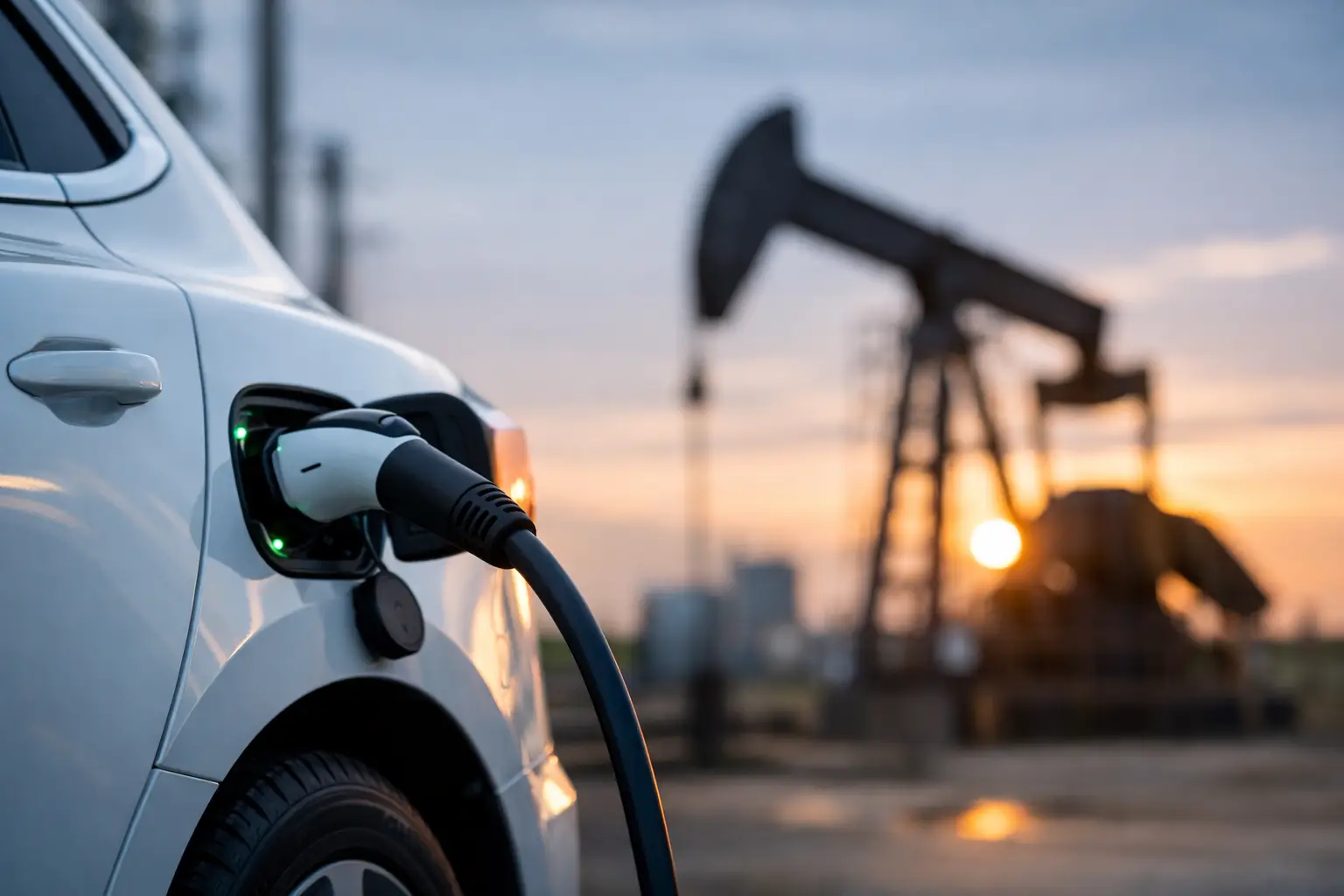

A single electric vehicle does not move the oil market. Millions of them do. That is the central fact behind how electric vehicles affect oil demand: EVs are steadily removing gasoline and diesel consumption from the transportation system, but the impact arrives unevenly across countries, fuel types, and time horizons.
For investors, consumers, and energy companies, the question is no longer whether electrification matters. It is whether EV adoption can outpace continued growth in global oil use from aviation, shipping, petrochemicals, trucking, and emerging-market mobility. The answer will shape crude prices, refinery profits, energy infrastructure spending, and the value assigned to oil producers for years.
EVs Target Oil’s Biggest Consumer Market
Road transportation has historically been the largest source of oil demand. Passenger cars and light trucks consume a significant share of the gasoline refined from crude, particularly in the United States, where larger vehicles and long driving distances have kept fuel use high.
Battery-electric vehicles change that equation because they use no gasoline or diesel at the tailpipe. A household that replaces a gasoline-powered SUV with an EV does not merely buy less fuel during a high-price month. It permanently lowers its direct demand for petroleum, assuming the vehicle remains on the road.
The individual effect can appear modest. An efficient gasoline vehicle driven 12,000 miles a year may consume roughly 400 to 600 gallons annually, depending on fuel economy. Scale that across a rapidly growing EV fleet, however, and the barrels add up. This is why oil forecasters track EV sales, total vehicles on the road, mileage, charging access, and turnover rates as closely as they track GDP growth.
The United States illustrates both the opportunity and the constraint. EV sales have gained market share, supported by federal tax credits, a wider range of models, and expanding charging networks. Yet the country has more than 280 million registered vehicles, and most are still powered by internal-combustion engines. It takes years for new sales to materially change the composition of such a large vehicle fleet.
Oil Demand Falls Slowly Before It Falls Fast
The market impact of EVs follows a delayed curve. New-vehicle sales can shift quickly when prices, incentives, technology, and consumer preferences align. Oil demand changes more gradually because cars and trucks often remain in service for a decade or longer.
That lag is crucial. A record year for EV sales may receive headlines, while gasoline demand remains resilient because the overall fleet is still dominated by combustion vehicles. Conversely, once EVs represent a meaningful portion of vehicles on the road, annual fuel displacement can accelerate without requiring another dramatic jump in market share.
China is the most consequential example. Its vast EV market, led by domestic manufacturers including BYD, has made the country a major source of reduced gasoline-demand growth. China also remains a large oil importer, industrial producer, and consumer of petrochemical feedstocks. That means EV growth can weaken one part of its oil consumption even while other parts continue to expand.
Europe provides another version of the same story. Fuel taxes, emissions rules, dense cities, and mature charging markets have encouraged electrification. But policy changes, price-sensitive buyers, and uneven charging access can still cause EV sales to fluctuate from one year to the next. Oil markets should not confuse a short-term sales slowdown with a reversal in the longer-term pressure on road-fuel demand.
Why Oil Use Can Still Grow During the EV Boom
Electric mobility does not eliminate global oil demand. It changes where demand growth comes from.
Oil is not used only to make gasoline. Refineries also produce diesel, jet fuel, marine fuel, lubricants, asphalt, and feedstocks used in plastics and chemicals. A surge in air travel, freight movement, construction, or petrochemical production can offset some of the barrels displaced by electric cars.
This is especially relevant in developing economies, where incomes, vehicle ownership, industrial activity, and travel demand are still rising. New drivers in India, Southeast Asia, Africa, and Latin America may add gasoline demand even as EVs reduce consumption in China, Europe, and parts of North America. In many of these markets, the affordability and availability of small electric vehicles, two-wheelers, and charging infrastructure will determine how quickly the transition reaches mass adoption.
Commercial transport is another variable. Passenger EVs are increasingly competitive, but electrifying heavy-duty trucking is harder. Long-haul trucks need large batteries, reliable high-speed charging, and minimal downtime. Some fleets may use battery power for shorter routes while retaining diesel for long-distance hauling. Alternatives such as hydrogen or renewable fuels may also play a role, though their cost and infrastructure requirements remain significant.
Aviation and shipping face even steeper technical barriers. These sectors rely on energy-dense liquid fuels and have fewer near-term substitutes at commercial scale. As a result, the first major effect of EVs is likely to be a structural slowdown in gasoline demand, not an immediate collapse in total crude consumption.
Refiners Feel the Pressure Before Producers Do
The effect of electric vehicles on oil demand is not identical for every company in the energy chain. Refiners may face the clearest early challenge because EVs directly reduce the need for gasoline, one of their core products.
A refinery cannot simply stop producing gasoline without affecting the rest of its output mix. Crude oil is processed into multiple products, and changing that mix requires capital investment, specialized equipment, and dependable demand for alternatives. Refiners that can produce more jet fuel, diesel, petrochemical feedstocks, or renewable fuels may be better positioned than facilities built around gasoline-heavy markets.
Oil producers, by contrast, sell into a global crude market. If gasoline demand weakens in one region, barrels can still be shipped elsewhere or processed into other products. That does not make producers immune. Over time, slower demand growth can reduce the need for new high-cost projects and put greater weight on low-cost production from countries and companies with strong balance sheets.
This is where the investment stakes become sharper. Oil demand does not need to plunge for prices and valuations to change. If expected demand growth falls from strong to modest, the market may need fewer new wells, pipelines, export terminals, and refinery expansions. Long-lived projects become harder to justify when future utilization is uncertain.
Electricity Demand Replaces Some Fuel Demand
EVs shift energy spending from gasoline stations to the electric grid. That does not mean the vehicles are energy-free. It means the fuel source moves upstream, from refined petroleum to power generation.
The climate and economic outcome depends partly on how electricity is produced. Charging from a grid dominated by coal has a different emissions profile than charging from nuclear, natural gas, hydroelectric power, wind, or solar. But from the oil market’s perspective, the central point remains: an EV generally displaces oil consumption even when the electricity comes from fossil fuels, because most U.S. power generation does not rely heavily on oil.
The shift creates winners beyond automakers. Utilities, charging-network operators, battery suppliers, grid-equipment manufacturers, and copper producers all have exposure to higher electricity demand and expanded charging infrastructure. It also creates new planning problems. Evening charging can strain local distribution systems, while managed charging and workplace charging can help move demand to lower-cost hours.
What Could Slow the Oil-Demand Effect?
The pace of displacement is not guaranteed. Higher interest rates can make EV financing less attractive. Lower gasoline prices reduce the immediate savings from driving electric. The expiration or revision of tax incentives can affect demand, as can trade policy and tariffs on imported vehicles and batteries.
Charging remains a practical concern, particularly for apartment residents, rural drivers, and households without private garages. Battery prices have fallen dramatically over the past decade, but vehicle affordability, insurance costs, repair networks, and resale values still influence purchase decisions.
There is also a rebound effect. Lower operating costs can encourage more driving, which reduces some energy savings. And a larger overall vehicle fleet can keep transportation energy demand elevated even if each new vehicle is more efficient.
The Market Signal to Watch
The most useful indicator is not a single monthly EV-sales report or a one-week move in crude prices. Watch the relationship between EV penetration, total vehicle miles traveled, refinery gasoline margins, and demand growth in major economies. Those measures show whether electrification is truly removing barrels from the system or merely slowing the rate at which consumption rises.
For oil markets, EVs are becoming less of a future scenario and more of a present demand calculation. The transition will not be linear, and it will not affect every barrel equally. But as electric vehicles gain share in the global fleet, the companies and investors that treat gasoline demand as permanently guaranteed may be the ones facing the most expensive adjustment.