
Artificial intelligence is expected to reshape nearly every sector of the economy over the next decade, but its impact on employment is unlikely to be evenly distributed.
According to Metaculus, a forecasting platform that tracks predictions across 15 representative U.S. occupations through 2035, healthcare professionals, particularly registered nurses, are projected to remain among the most resilient careers, while legal professionals face the steepest expected decline as AI becomes more capable of performing knowledge-intensive work.
Rather than predicting widespread job elimination, the forecasts suggest AI will increasingly automate specific tasks, changing how professionals work while affecting occupations differently depending on the nature of their responsibilities.
Registered Nurses Lead Employment Growth
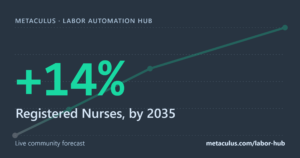
Among the occupations tracked by Metaculus, registered nurses are expected to experience the strongest projected growth, with employment forecast to increase by 9% through 2035.
Despite rapid advances in AI-powered healthcare technologies, forecasters broadly agree that demographic trends are likely to outweigh automation. The aging U.S. population is expected to continue driving demand for healthcare professionals, while AI primarily assumes administrative and documentation tasks.
Professional forecaster Zaldath argues that AI could improve efficiency without materially reducing the need for nurses. “Some routine (digital) administrative tasks can probably be handled by AI tools pretty well in upcoming years. This may put a slight amount of downward pressure on the growing demand for nurses. However, there is considerably more pressure in the opposite direction. Most of the pressure comes from the rapidly aging general U.S. population.”
Professional forecaster Nathan Metzger (Haiku) shares a similar view. “I’m still skeptical even over the course of a decade that AI will materially negatively affect nursing roles.”
Meanwhile, professional forecaster Yann Riviere (exmateriae) expects AI to increase productivity across healthcare while preserving employment demand. “This looks like a category where AI should raise productivity materially without making the occupation especially vulnerable in share terms by 2030. By 2035, I can imagine a lot more leverage per nurse and a lot of auxiliary work being automated, but I still think demographic demand and the hands-on nature of care make this category much more resilient than most.”
Together, the forecasts suggest that occupations combining technical expertise, direct patient care and interpersonal interaction remain among the least exposed to AI-driven displacement.
Legal Profession Faces the Largest Projected Decline
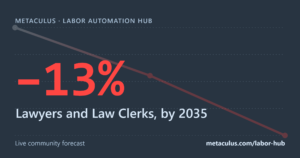
At the opposite end of the ranking, lawyers and law clerks record the largest projected decline among the 15 occupations tracked, with employment expected to decrease by 13.3%.
The projections reflect AI’s growing ability to perform legal research, review contracts, analyze documents and generate written content—tasks that have traditionally required significant human effort.
Even so, forecasters disagree on whether the legal profession’s close relationship with regulation could slow automation.
Professional forecaster Yann Riviere (exmateriae) believes lawyers may have an unusual ability to shape the rules governing AI. “There is a ton of overlap between politics and lawyers… I think there is a strong chance that one of the first professions to be completely protected from AI might be the lawyers, even in some cases if it means making things worse for everyone.”
Others see regulation providing only limited protection.
Professional forecaster Nathan Metzger (Haiku) argues that legal work could experience meaningful substitution while maintaining the need for human oversight. “In the perhaps minority of worlds in which lawyers are unable to safeguard their profession from automation, I suspect there will be a significant amount of replacement. I also see this profession as a rare one in which the old adage of ‘you won’t be replaced by AI; you’ll be replaced by someone using AI’ actually rings true to me. I can’t see this profession disappearing entirely, even in the very long term, because of the strong need for human accountability.”
The differing views illustrate the uncertainty surrounding how quickly AI will reshape professional services, particularly in highly regulated industries.
Financial Specialists Could See Entry-Level Roles Most Affected
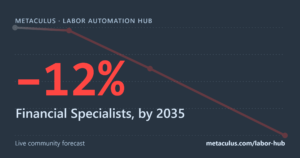
Metaculus projects a more modest 1.1% decline for financial specialists, but forecasters suggest the impact may be concentrated in junior and routine positions rather than across the profession as a whole.
Professional forecaster Ľuboš Saloky believes AI will disproportionately affect entry-level knowledge work. “Automation risk is severe and concentrated in entry-level and routine roles. While the profession won’t disappear, job losses are inevitable. The real danger is a hollowed middle: fewer junior positions to build the next generation of senior professionals.”
Nathan Metzger similarly argues that finance belongs to a broader category of occupations highly exposed to AI. “Knowledge work is especially exposed to replacement by AI, and financial specialists are no exception.”
However, another Metaculus forecaster, Hippopotamus_bartholomeus, notes that accountability requirements continue to limit AI adoption in areas such as accounting and auditing. “Trust does not currently exist at scale to leave the integral parts of (public) accounting to AI, since auditors are liable for their opinion and companies for the correctness of their financial statements.”
The consensus suggests AI is more likely to transform financial careers by automating repetitive analytical work than to replace professionals responsible for oversight, compliance and fiduciary judgment.
AI’s Impact Will Vary Across Occupations
Metaculus’ latest forecasts highlight significant differences in how AI is expected to influence employment through 2035.
Projected Employment Declines
- Lawyers and law clerks (−13.3%)
- Services sales representatives (−12.6%)
- Software developers (−7.2%)
- General managers (−6.0%)
- Janitors and cleaners (−4.5%)
- K-12 teachers (−4.4%)
- Designers (−3.6%)
- Laborers and movers (−2.7%)
- Engineers (−1.8%)
- Financial specialists (−1.1%)
Projected Employment Growth
- Registered nurses (+9.0%)
- Physicians (+4.6%)
- Law enforcement (+4.1%)
- Construction workers (+3.5%)
- Restaurant servers (+2.4%)
The projections indicate that occupations centered on physical interaction, caregiving, public safety and hands-on services remain comparatively resilient, while roles involving repetitive cognitive work, document processing and standardized knowledge tasks face greater exposure to automation.
AI Is Expected to Transform Jobs More Than Eliminate Them
Across the forecasts, a common theme emerges: artificial intelligence is expected to redefine work rather than replace entire professions.
For many occupations, AI is projected to automate routine tasks, improve productivity and shift the value of human labor toward judgment, accountability, creativity and interpersonal skills.
As businesses continue integrating AI into daily operations, the challenge is becoming less about identifying which jobs will disappear and more about understanding how occupations will evolve, and which skills will remain indispensable in an increasingly AI-enabled economy.
Source: Metaculus labor market forecasts tracking 15 representative U.S. occupations through 2035.