
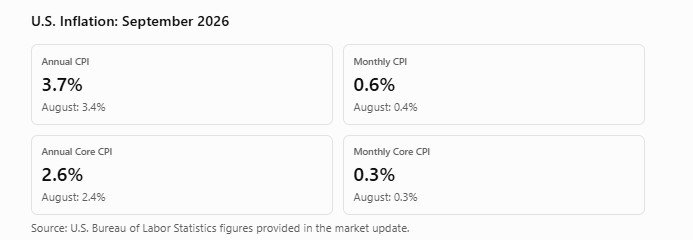
U.S. annual inflation accelerated to 3.7% in September 2026, up from 3.4% in both July and August, as rising energy prices pushed consumer costs higher, according to figures attributed to the U.S. Bureau of Labor Statistics (BLS).
The Consumer Price Index (CPI) exceeded economists’ expectations of 3.6%, reflecting a sharp increase in gasoline and fuel oil prices alongside continued increases in housing and several service categories.
On a monthly basis, consumer prices rose 0.6%, compared with 0.4% in August. The increase matched market forecasts and represented the largest monthly gain in five months.
The report underscores the influence of energy costs on U.S. inflation and the challenges facing households, businesses and monetary policymakers.
Gasoline and Fuel Oil Lead Inflation Increase
Energy prices were the principal contributors to September’s acceleration.
Gasoline prices increased 34.2% compared with the same month a year earlier, accelerating from a 27.4% annual increase in August.
Fuel oil prices rose even more sharply, climbing 74.2% year over year, compared with 52% in the previous month.
On a monthly basis, gasoline prices jumped 9.1%, accounting for more than half of the overall increase in the CPI.
These developments illustrate how changes in global energy markets can quickly affect household expenses.
Higher fuel prices also have broader economic implications, potentially increasing transportation and distribution costs for businesses, although the extent to which those costs are passed on to consumers varies across industries.
Housing Inflation Accelerates While Food Prices Moderate
Housing costs continued to contribute to inflationary pressures.
The annual increase in shelter prices accelerated to 3.2% in September, compared with 3.0% in August.
Shelter is one of the largest components of the Consumer Price Index, making changes in housing costs particularly important to the overall inflation outlook.
Food inflation, however, showed signs of moderation.
Food prices increased 2.5% over the previous 12 months, down from 2.7% in August.
On a monthly basis, food prices were unchanged, providing some relief from the broader increase in consumer costs.
The slowdown in food inflation does not necessarily mean grocery prices have declined. Rather, it indicates that prices are rising more slowly than before.
Core Inflation Rises Above Expectations
Inflation excluding the volatile food and energy categories also accelerated.
Annual core CPI increased to 2.6% in September, compared with 2.4% in August, exceeding market expectations of 2.5%.
On a monthly basis, core inflation remained at 0.3%, unchanged from August and above forecasts of a slowdown to 0.2%.
Core inflation is closely monitored by economists and the Federal Reserve because it can provide insight into underlying price pressures beyond short-term fluctuations in food and energy markets.
The September figures suggest that inflationary pressures were not limited to energy.
Prices also increased for recreation, used cars and trucks, education, airline fares, medical care and apparel.
Communication prices declined during the month.
U.S. Inflation: September 2026
What Higher Inflation Means for Businesses and Consumers
The acceleration in consumer prices has implications beyond household budgets.
For businesses, rising energy costs can increase expenses associated with transportation, manufacturing, logistics and commercial operations.
Companies may respond by absorbing higher costs, adjusting prices or reviewing investment and hiring decisions.
For consumers, sustained increases in essential expenses can reduce purchasing power and limit spending on discretionary goods and services.
The effects can also extend to financial markets.
Higher-than-expected inflation may influence expectations about the Federal Reserve’s interest rate decisions, particularly if price pressures remain persistent.
However, monetary policy decisions depend on a broader set of economic indicators, including employment, wage growth and financial conditions.
Federal Reserve Faces Renewed Inflation Pressures
The September report presents a mixed picture for policymakers.
While food inflation moderated, energy prices rose sharply and core inflation exceeded expectations.
The distinction matters because the Federal Reserve generally has limited ability to influence global energy prices directly through interest rate policy.
At the same time, persistent price increases across housing, services and other consumer categories may complicate efforts to restore price stability.
The Federal Reserve’s long-term inflation target is 2%, measured using the Personal Consumption Expenditures (PCE) price index rather than the CPI.
September’s consumer inflation figures therefore add to the information policymakers must evaluate when assessing the appropriate path for interest rates.
The trajectory of inflation in the coming months will depend partly on energy markets, domestic demand and whether price pressures spread further across the economy.
Source: U.S. Bureau of Labor Statistics (BLS), September 2026 Consumer Price Index figures as supplied. The figures in this article have not been independently cross-checked against the original statistical release.