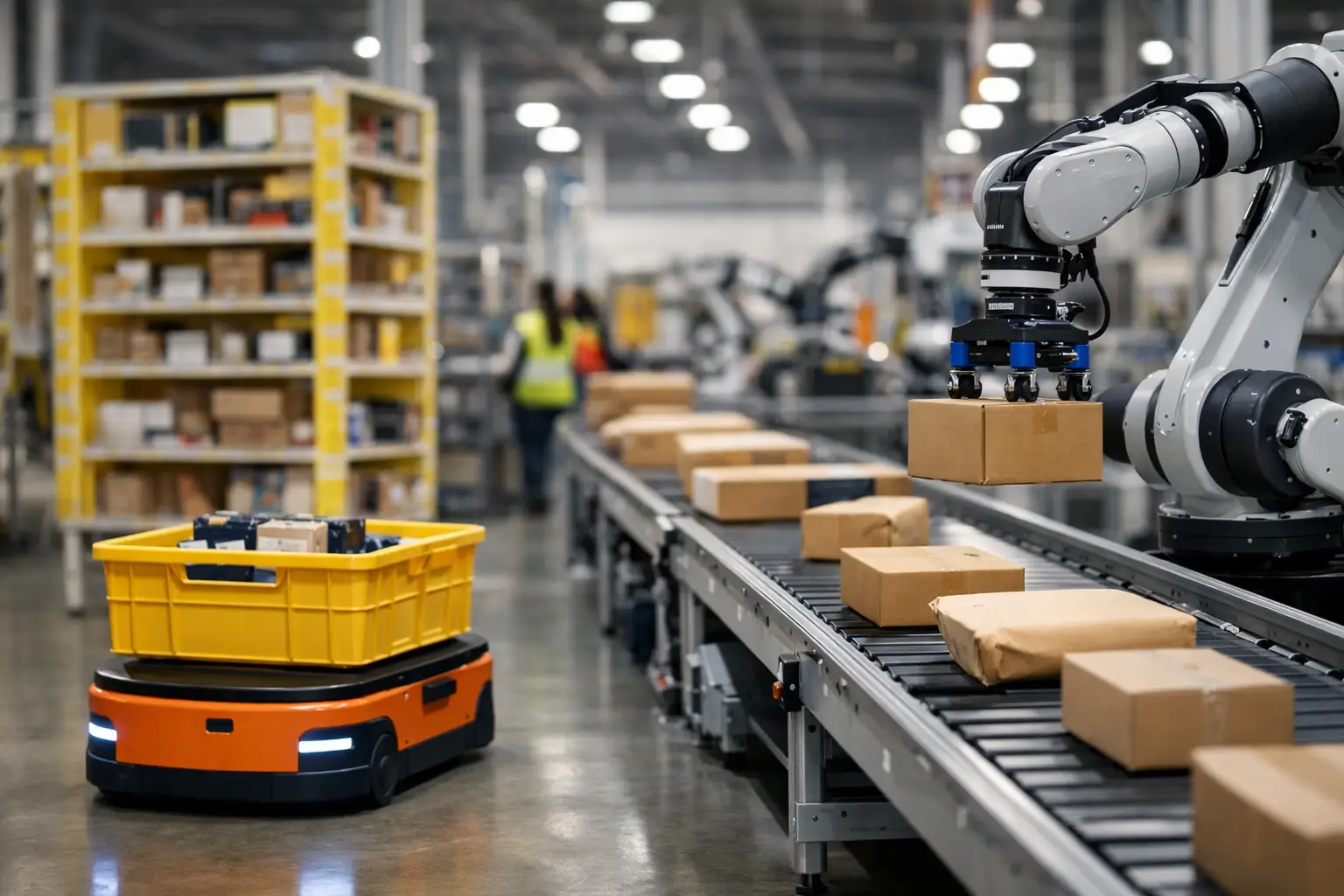

A single Amazon fulfillment center can now look less like a conventional warehouse and more like a capital-intensive technology operation. This Amazon warehouse automation case study examines the business logic behind that shift: Amazon is deploying robots, computer vision, software, and redesigned facilities to move more units with less travel, faster delivery promises, and tighter control over a vast logistics network.
The stakes extend well beyond e-commerce. Amazon’s warehouse decisions influence industrial real estate, robotics suppliers, transportation capacity, labor markets, and the expectations investors place on retailers trying to match its delivery speed. The company is not simply replacing people with machines. It is redesigning where work happens, which tasks can be standardized, and how inventory moves through a network built for enormous volume.
The operating problem Amazon needed to solve
Amazon’s core logistics challenge is scale combined with volatility. Order volumes surge around Prime Day and the holiday season. Product sizes range from books and phone cases to furniture and appliances. Customer expectations have shifted from two-day shipping to same-day or next-day delivery in many markets.
A traditional warehouse model puts much of the burden on workers walking long distances to locate, pick, and bring products to packing stations. That process becomes expensive as order density rises. It also creates bottlenecks when demand spikes, labor availability tightens, or a facility handles a wider mix of goods.
Amazon began addressing that issue at scale with its 2012 acquisition of Kiva Systems, later renamed Amazon Robotics. The reported $775 million purchase gave the company a mobile-robot platform that could bring storage pods to workers rather than requiring workers to travel warehouse aisles. It was an early signal that Amazon viewed fulfillment technology as a strategic asset, not a back-office efficiency project.
Amazon warehouse automation case study: What changed
The central change was a move from person-to-product operations toward goods-to-person systems in selected facilities. Small, flat mobile robots move shelving units or pods across marked warehouse floors to workstations, where employees pick items for orders. Software decides where inventory sits and which pod should be sent next.
The impact comes from reducing unproductive travel. A worker can spend more time handling items and less time walking between storage locations. That sounds straightforward, but it changes facility design, inventory placement, labor scheduling, safety procedures, and the economics of each package shipped.
Amazon later expanded well beyond mobile robots. Its automation portfolio has included robotic arms for sorting and handling, automated conveyance, package-labeling systems, computer vision tools, and autonomous mobile robots designed to work around people. The company has also introduced newer fulfillment-center designs intended to store more inventory and process customer orders closer together.
The strategy is not uniform. A highly automated facility makes the most sense where order volume, product profile, and throughput justify the capital spending. Bulky items, irregular products, fragile goods, and fast-changing workflows can still require substantial human intervention. This is one reason warehouse automation is not a simple story of machines taking over every task.
The financial logic: Fixed investment for variable demand
Automation raises upfront costs. Robots, sensors, conveyors, software integration, maintenance systems, and facility redesign can require substantial capital. That investment must be weighed against wage costs, employee turnover, injury risk, order error rates, delivery speed, and the cost of operating extra space.
For Amazon, the payoff is likely measured across the network rather than at one warehouse alone. Faster fulfillment can support more attractive delivery promises, increase Prime membership value, reduce split shipments, and position inventory more efficiently. A machine that saves seconds at one workstation can matter when multiplied across millions of packages.
This is especially relevant to Amazon’s profitability story. Its North America retail segment historically operated on thinner margins than Amazon Web Services and advertising. Logistics productivity therefore carries unusual importance. When fulfillment costs improve relative to unit volume, the effect can strengthen operating leverage in retail even if the company continues spending heavily on technology and capacity.
Investors should avoid treating every robot deployment as instant margin expansion. Depreciation, maintenance, downtime, training, and integration costs can offset early savings. Automation can also create a more complicated cost structure: labor needs may decline in one role while rising for technicians, engineers, safety staff, and systems operators.
Speed is the customer-facing return on investment
The clearest commercial result of warehouse automation is speed. Amazon’s delivery promise depends on having the right item near the buyer, processing the order quickly, and moving it into a transportation network with minimal delay. Warehouse robotics addresses the middle of that equation.
Faster operations can reduce cutoff times for same-day and next-day orders. It can also make local inventory more useful because facilities can process a greater number of orders in a shorter window. That matters in metropolitan areas where consumers are increasingly accustomed to rapid delivery but where last-mile transportation remains expensive.
The competitive pressure is real. Walmart, Target, grocery chains, third-party logistics providers, and specialized e-commerce operators have all invested in automation to varying degrees. Amazon’s advantage is not necessarily that it owns a single superior robot. Its bigger edge is the combination of software, purchasing data, fulfillment infrastructure, and delivery network scale.
That distinction matters. A retailer can buy automated equipment, but it cannot quickly replicate years of demand data, millions of product relationships, and a national logistics footprint. In automation, the machine is only one part of the system.
Labor: Fewer miles walked, different jobs created
The labor implications remain the most contested part of the case study. Amazon has argued that technology can remove repetitive physical tasks and improve workplace safety. Critics, labor groups, and regulators have raised concerns about production quotas, injury rates, monitoring, and whether automation can intensify work even when it reduces walking.
Both dynamics can exist at the same time. A robot may reduce the distance an employee travels, yet the resulting workflow may demand a faster, more tightly measured pace. The outcome depends on task design, staffing levels, ergonomics, maintenance reliability, and the performance targets set by management.
Automation also changes the skills a warehouse network needs. Demand rises for maintenance technicians, controls specialists, robotics engineers, data analysts, and operations managers who can troubleshoot complex equipment. Those roles often command higher pay and require more training than entry-level picking jobs, but they do not necessarily appear in the same locations or at the same scale.
For communities hosting large fulfillment centers, that creates a mixed economic picture. New facilities can generate construction spending, tax revenue, and jobs, while also changing the local labor market’s requirements. Policymakers evaluating warehouse projects increasingly need to consider job quality and training pipelines alongside headline employment totals.
What the model reveals about Amazon’s broader strategy
Amazon’s automation push is best viewed as a supply-chain strategy with an artificial intelligence layer, not a stand-alone robotics bet. Every automated decision about storage, picking, routing, and packing produces operational data. That data can help the company forecast demand, allocate inventory, identify bottlenecks, and decide where to add capacity.
The approach also gives Amazon flexibility during disruption. Labor shortages, volatile fuel prices, port congestion, and sudden demand changes all expose weaknesses in a manually intensive network. Automation does not eliminate those risks, but it can make operations more predictable when systems are properly maintained and inventory is in the right place.
There are limits. Highly centralized, technology-heavy operations can be vulnerable to software failures, equipment outages, cyber risks, or flawed forecasting. More automation can also reduce flexibility if a facility is optimized for a narrow flow of goods and consumer demand changes abruptly. The most effective networks preserve room for people to handle exceptions.
The takeaway for investors and business leaders
Amazon’s warehouse strategy shows why logistics is becoming a major competitive battlefield. Retailers no longer compete only on product selection and price. They compete on fulfillment accuracy, delivery speed, labor productivity, and the capital discipline required to keep improving all three.
For investors, the key question is not how many robots Amazon deploys. It is whether automation lowers the cost to serve each order while protecting customer experience and supporting profitable growth. For operators, the lesson is more practical: automate the repetitive, high-volume constraints first, but do not confuse expensive equipment with a complete operating strategy.
The next meaningful signal will come from execution, not announcements. Watch delivery speeds, fulfillment costs, retail operating margins, capital expenditures, and workforce outcomes together. That is where the real value of warehouse automation becomes visible.